


This is the VOA Special English Technology Report.
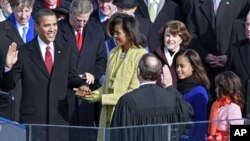
We have all witnessed the power of social media. It helped elect Barack Obama president in two thousand eight. It also helped to support popular revolutions in two thousand ten and eleven that forced several long-time rulers from office.
Now, research suggests that social networks could have an even greater effect on elections, helping to increase the number of people who vote.
The new report appeared in the journal Nature. It estimates that about one third of a million more people voted in America’s two thousand ten congressional elections all because of a single message on Facebook.
James Fowler is a political science professor at the University of California, San Diego. He led the research in partnership with Facebook’s Data Science team. They studied the effect of a “get out the vote” message on more than sixty million Facebook users. The social network placed the message at the top of their Facebook news feeds on Election Day two thousand ten.
JAMES FOWLER: “And in the message, there was button that says ‘I Voted’.” There was also a link that you could click on that allowed you to look up your polling place. And in some of the messages we also showed people the pictures of their friends who had clicked on the ‘I Voted’ button earlier in the day.”
We spoke to Professor Fowler on Skype. He says the team later compared this information to publicly available voting records.
JAMES FOWLER: “And one of the remarkable things that we found was that when we were comparing the people who received these messages to the people who received no messages, the people who saw the message without the faces of their friends actually voted at exactly the same rate as the people who saw no message at all. But the people who saw faces of their friends they actually voted more.”
The researchers say the results of the study show that the message directly influenced about sixty thousand extra people to go and vote. Even more importantly, says Professor Fowler, the friends of the people who saw the message also were influenced to vote. He says this led an additional two hundred eighty thousand people to take part in the elections. As a result, the message influenced a total of three hundred forty thousand people.
And, Professor Fowler says the experiment led to an even more interesting finding. It is that in the world of social networking, like in the real world, not all friends are equal.
JAMES FOWLER: “It wasn’t all of these online connections that matter. The average person on Facebook today has about one hundred fifty friends. And when we just looked at the close friends, those closest ten people on Facebook, we found that they were driving the whole effect. That all of the extra two hundred eighty thousand voters were coming from just ten out of your one hundred fifty friends.”
The researchers say the study suggests that voting is a social behavior. They say social networking may be the best way to get more people involved in the democratic process. And they think this in not only true in politics, but in other areas as well, including public health.
And that's the VOA Special English Technology Report, written by June Simms. I'm Steve Ember.
We have all witnessed the power of social media. It helped elect Barack Obama president in two thousand eight. It also helped to support popular revolutions in two thousand ten and eleven that forced several long-time rulers from office.
Now, research suggests that social networks could have an even greater effect on elections, helping to increase the number of people who vote.
The new report appeared in the journal Nature. It estimates that about one third of a million more people voted in America’s two thousand ten congressional elections all because of a single message on Facebook.
James Fowler is a political science professor at the University of California, San Diego. He led the research in partnership with Facebook’s Data Science team. They studied the effect of a “get out the vote” message on more than sixty million Facebook users. The social network placed the message at the top of their Facebook news feeds on Election Day two thousand ten.
JAMES FOWLER: “And in the message, there was button that says ‘I Voted’.” There was also a link that you could click on that allowed you to look up your polling place. And in some of the messages we also showed people the pictures of their friends who had clicked on the ‘I Voted’ button earlier in the day.”
We spoke to Professor Fowler on Skype. He says the team later compared this information to publicly available voting records.
JAMES FOWLER: “And one of the remarkable things that we found was that when we were comparing the people who received these messages to the people who received no messages, the people who saw the message without the faces of their friends actually voted at exactly the same rate as the people who saw no message at all. But the people who saw faces of their friends they actually voted more.”
The researchers say the results of the study show that the message directly influenced about sixty thousand extra people to go and vote. Even more importantly, says Professor Fowler, the friends of the people who saw the message also were influenced to vote. He says this led an additional two hundred eighty thousand people to take part in the elections. As a result, the message influenced a total of three hundred forty thousand people.
And, Professor Fowler says the experiment led to an even more interesting finding. It is that in the world of social networking, like in the real world, not all friends are equal.
JAMES FOWLER: “It wasn’t all of these online connections that matter. The average person on Facebook today has about one hundred fifty friends. And when we just looked at the close friends, those closest ten people on Facebook, we found that they were driving the whole effect. That all of the extra two hundred eighty thousand voters were coming from just ten out of your one hundred fifty friends.”
The researchers say the study suggests that voting is a social behavior. They say social networking may be the best way to get more people involved in the democratic process. And they think this in not only true in politics, but in other areas as well, including public health.
And that's the VOA Special English Technology Report, written by June Simms. I'm Steve Ember.