United States Treasury Secretary Tim Geithner speaking to the Council on Foreign Relations in Washington.
Read, listen and learn English with this story. Double-click on any word to find the definition in the Merriam-Webster Learner's Dictionary.
This is the VOA Special English Economics Report.
Pressure for financial reform is building in Europe. This week the financial services company Moody’s Investors Service reduced Spain’s credit rating. The rating was cut from A3 to baa3. That means that Moody’s judges the credit risk of Spanish debt has moved from very low to moderate.
The company said it acted because Spain is borrowing about one hundred twenty-five billion dollars in rescue loans for its banks.
Debt markets punished Spain by pushing up the interest rate on its long-term debt to about six point eight percent. That increases Spain’s borrowing costs and hurts its already troubled economy. Spain was not the only country to get downgraded by Moody’s. Cyprus got the same treatment.
On Wednesday, American Treasury Secretary Tim Geithner spoke at the Council on Foreign Relations in Washington. He said the increase in borrowing costs for European countries like Spain means European officials must move quickly to avoid growing costs.
TIM GEITHNER: “If you wait to move in these things and you let the market get ahead of you, then you increase the costs of the solution and you make it harder to get there--you get too much momentum—it’s very costly. Once you decide, there’s no argument for doing it slowly.”
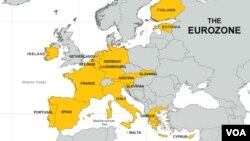
A map of Eurozone nations
Germany, Europe’s largest economy, has been pushing for economic reform in the seventeen countries using the euro. But German Chancellor Angela Merkel has argued that her country is unwilling to put money at risk unless banking reform is enacted throughout the Eurozone. She warned this week that Germany’s economic power was not unlimited.
Earlier this month, the European Commission proposed steps toward a common banking policy. The proposals include empowering nations to intervene when their banks are in trouble. But proposed changes may also bar support for failing banks.
Some European leaders are pressing for an expanded European bailout fund. Germany has resisted providing new financial resources. But details of any deal with big European economies have yet to be decided.
Europe’s financial crisis is likely to be the main issue at the G-20 economic meeting in Mexico next week. Secretary Geithner is looking forward to the conference.
TIMOTHY GEITHNER: “you know, the world is waiting for them, they have a -- they have a big incentive to add as much clarity to those plans as early as they can.”
And that's the VOA Special English Economics Report. For transcripts, MP3s and now PDFs of our programs for e-readers, go to voaspecialenglish.com. And follow us on Facebook and iTunes at VOA Learning English. I'm Mario Ritter.