Read, listen and learn English with this story. Double-click on any word to find the definition in the Merriam-Webster Learner's Dictionary.
STEVE EMBER: Welcome to THE MAKING OF A NATION – American history in VOA Special English. I’m Steve Ember.
Today we start our series again from the beginning. The last time we started over was in October of two thousand seven.
(MUSIC)
► Listen to this story in high-quality 192kbps audio (or right-click/option-click to save)
THE MAKING OF A NATION is one of the most popular programs in VOA Special English.
It started in May of nineteen sixty-nine. Some longtime listeners can remember when THE MAKING OF A NATION was on the radio twice a week. People who grew up listening to it are old enough now to listen with their own children, or even their grandchildren.
The series tells a story. You can think of it not just as a series of programs about the history of America and its people, but a series of lessons. The subjects include exploration, revolution, civil war, social and political change, the rise of industry and modern technology, and more.
As time adds to the story of American history, we add to our series. We finished in May at program number two hundred forty. The subject was the Great Recession and the presidential election of two thousand eight.
Over the last year, we took our series in a new direction. We added more sound from the people who made history in the twentieth century ...
PRESIDENT FRANKLIN ROOSEVELT: "Yesterday, December seventh, nineteen forty-one, a date which will live in infamy, the United States of America … "
President Richard M. Nixon and his wife Pat Nixon
PRESIDENT RICHARD NIXON: "Throughout the long and difficult period of Watergate, I have felt it was my duty to persevere – to make every possible effort to complete the term of office."
More sound from popular culture and entertainment ...
(SOUND: Dialogue from the movie "Gone with the Wind," with Clark Gable as Rhett Butler and Vivien Leigh as Scarlett O’Hara)
RHETT BUTLER: "That’s what’s wrong with you. You should be kissed, and often, and by someone who knows how."
SCARLETT O’HARA: "Oh, and I suppose you think you’re the proper person."
(SOUND: Larry Hagman as J.R. from the television series "Dallas")
J.R: "Your daddy lacked the killer instinct -- he forgave those who transgressed against him. People just weren’t afraid of him.
(SOUND: Lucille Ball and Desi Arnaz as Lucy and Ricky Ricardo from the TV series "I Love Lucy")
LUCY: "Ah, what’ll I have to do?"
RICKY: "You gonna get me back on the television show."
LUCY: "How?"
RICKY: "I don’t know how, but if you don’t …"
LUCY: "I will, Ricky. I’ll get you back on the show. Don’t even think of what you’ll do if I don’t."
(SOUND: Michael Douglas as Gordon Gecko from the film "Wall Street")
GORDON GECKO: "The point is, ladies and gentlemen, that greed, for lack of a better word, is good. Greed is right. Greed works."
And more sound from the events that defined the times.
(SOUND: General Dwight Eisenhower after the D-Day invasion on June 6, 1944)
DWIGHT EISENHOWER: "People of Western Europe: a landing was made this morning on the coast of France by troops of the Allied Expeditionary Force."
General Dwight Eisenhower.
DWIGHT EISENHOWER: "This landing is part of a concerted United Nations plan for the liberation of Europe."
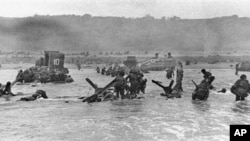
Some of the first assault troops to hit the beach of Normandy, France, on June 6, 1944 take cover behind enemy obstacles to fire on German forces as others follow the first tanks through the water toward the German-held shore during World War II
One of our programs, on the D-Day invasion during World War Two, was a finalist for most creative radio feature in the twenty-eleven Association for International Broadcasting Media Awards:
(SOUND: Excerpt from Nation #193]
On June fifth, nineteen forty-four, a huge Allied force waited for the order to invade German-occupied France.
All eyes turned toward Eisenhower. The decision was his. His face was serious. And for a long time he was silent. Finally he spoke. "OK," he said. "We will go."
(MUSIC)
In a sense, THE MAKING OF A NATION is living history. Our programs are still broadcast on radio. But now -- thanks to one of the defining events in modern history, the invention of the Internet -- they are also available online.
(MUSIC)
So how was the nation made? Why did people rebel against one nation and start their own? THE MAKING OF A NATION answers these and other questions about American history.
We will tell the story of how a group of farmers, businessmen and lawyers wrote a document they called the Constitution of the United States. On September seventeenth, seventeen eighty-seven, delegates to the Constitutional Convention in Philadelphia met one last time to sign it.
The Constitution became a guide not just for Americans, but also for other governments in creating democracies.
We will explore why the writers of the Constitution included guarantees of freedom of speech and religion, and the right to a fair and public trial.
We will also talk about the reasons for the American Revolution. One of the most important reasons was the idea that citizens of a country should have a voice in its decisions.
British citizens in the American colonies paid taxes but had no representatives in the British Parliament. Taxation without representation would lead to growing anger in the American colonies.
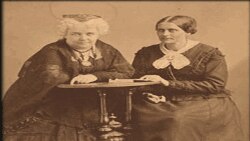
Suffragettes Elizabeth Cady Stanton and Susan B. Anthony
The leaders of the revolt made important changes. For example, all free men who owned land and paid taxes were permitted to vote. Not until nineteen twenty, however, did the Constitution guarantee women the right to vote.
Later, another change lowered the voting age for Americans from twenty-one to eighteen.
Our programs will explain the thinking behind these and other rights. They will also tell the story of each presidential election and presidency in American history.
THE MAKING OF A NATION explores the good and the bad in American history. For example, how could slavery exist in a nation whose people declared that "all men are created equal" and with a right to life, liberty and the pursuit of happiness?
Many of our programs explore the ideas and issues that have shaped the United States. But most importantly, they talk about the people.
(MUSIC)
For example, George Washington was a farmer before he became a military commander. He became president because the citizens of the new country wanted him as their first leader.
After two terms, Washington gave up power by his own choice. He once again became a farmer and a private citizen. In his farewell address in seventeen ninety-six, he warned Americans about the dangers of political parties.
Thomas Jefferson wrote the Declaration of Independence. It told the world that the people of this new country would no longer answer to a European ruler.
Some of the people who formed the United States into a nation during the seventeen hundreds were well educated and wealthy. Abraham Lincoln was not. Still, he grew up to become president.
Abraham Lincoln became president during the eighteen sixties when several southern states decided they no longer wanted to be part of the Union. We tell the story of how President Lincoln dealt with the terrible Civil War that almost split the country apart.
One of our programs will focus on the speech he gave in the little town of Gettysburg, Pennsylvania. A great battle had been fought there. President Lincoln had been asked to come to Gettysburg to say a few words at the dedication of a military burial ground.
The speech was short. President Lincoln honored the young men who had died on that bloody battlefield. He also told the world why the war was being fought and why it was so important.
Lincoln’s "Gettysburg Address" began with these words:
"Four score and seven years ago, our fathers brought forth on this continent a new nation, conceived in liberty, and dedicated to the proposition that all men are created equal."
Those words were just the first sentence. After President Lincoln wrote the speech, he felt sad. He considered it a failure. In fact, his words earned the respect of history. You can hear the full Gettysburg Address in our programs about the life and presidency of Abraham Lincoln.
(MUSIC)
THE MAKING OF A NATION touches on many different subjects. One of them is social change. For example, we discuss the changes that took place during the so-called Roaring Twenties.
In the nineteen twenties, many young people decided they no longer needed to follow the conservative traditions of their parents and grandparents. This was also the age of jazz.
But music and social values were not the only things changing. The Roaring Twenties were also a time of fast-moving economic change. Productivity grew sharply. At the same time, the divide between rich and poor Americans grew wider.
By the end of the twenties, the economy was ready to collapse. Then, in October of nineteen twenty-nine, the stock market crashed. What followed was an economic disaster worse than any the modern world has ever known.
We will examine the causes of the Great Depression and how it affected Americans and the rest of the world.
We will tell the story of people who lost their jobs, their homes and their hope for the future.
PRESIDENT FRANKLIN ROOSEVELT: "This great Nation will endure as it has endured, will revive and will prosper. So, first of all, let me assert my firm belief that the only thing we have to fear is fear itself."
Franklin Roosevelt was elected with a promise to bring the country out of the Depression. On March fourth, nineteen thirty-three, he was inaugurated to his first of four terms. He served longer than any other president in American history. We discuss Roosevelt's New Deal programs and his leadership during World War Two.
But not all of our subjects are so serious. We also look at the history of American popular culture.
(SOUND: From the "Burns and Allen" radio program]
GRACIE ALLEN: "Another cup of Maxwell House Coffee, George?"
GEORGE BURNS: "Sure, pour me a cup, Gracie"
(MUSIC: "Let's Dance"/Benny Goodman)
(SOUND: Excerpt from Nation #184)
The most popular sound of the nineteen thirties was a new kind of music called "Swing." And the "King of Swing" was a clarinet player named Benny Goodman.
(SOUND: Excerpt from Nation #206]
The painter Jackson Pollock represented a spirit of rebellion in art. Pollock would drop paint onto a canvas. What did his works mean? People had to decide for themselves.
Singer Elvis Presley began six years of service in the United State Army in nineteen fifty-eight
In music, the rebel was Elvis Presley -- the king of rock and roll.
(MUSIC: "Don't Be Cruel"/Elvis Presley)
The Beatles – four rock 'n' roll musicians from Liverpool.
(MUSIC: "I Want to Hold Your Hand"/The Beatles)
(SOUND: From the TV series "All in the Family")
ARCHIE (CARROLL O'CONNOR): "Lemme hear your idea again."
MICHAEL (ROB REINER): "OK, I want us to watch Jack Lemmon and a group of famous scientists discuss pollution and ecology on Channel Thirteen."
ARCHIE: "Good. And I wanna watch football highlights on Channel Two. Now guess what’s gonna happen."
(MUSIC)
In bookstores, the growing number of self-help books offered another sign of social change. These books advised people about ways to make themselves happier.
And we discuss subjects like the rise of high technology.
(SOUND: Excerpt from Nation #197)
President Abraham Lincoln and Congress established the National Academy of Sciences during the Civil War in the eighteen sixties. And in the early nineteen hundreds, the nation created scientific offices to study and improve agriculture, public health, even air travel.
(SOUND: Excerpt from Nation #208]
NASA ANNOUNCER: "Lift off of Apollo 11."
On July sixteenth, nineteen sixty-nine, three American astronauts lifted off in Apollo 11.
(SOUND: Excerpt from Nation #225)
TV ANNOUNCER: "You don’t have to be a genius to use a computer. Let Computer Land show you how easy it is to manage your own small business or home finances with the Atari 800."
In other words, something for everyone.
(MUSIC)
We begin our story of American history next week.
You can find our series online with texts, MP3s, podcasts and pictures at voaspecialenglish.com. You can also follow us on Facebook and Twitter at VOA Learning English. I’m Steve Ember, inviting you to join us again next week for THE MAKING OF A NATION -- American history in VOA Special English.