


This is the VOA Special English Education Report.
June, July and August are vacation months for most American school children. But some young students pay a high price for that long summer break. They may forget much of what they learned over the past year by the time they start the next grade.
This problem is often called the summer learning gap. A growing effort across the country aims to deal with it by offering more interesting summer school programs. Some students already attend summer school, but often because they received poor grades during the regular school year.
STUDENT: "People need food, clothes, and other goods …"
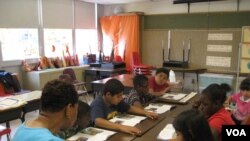
On a recent day, students read out loud about communities in a third-grade social studies class at Bushman Elementary in Dallas, Texas. But the nine- and ten-year-olds were also studying art. Visual arts instructor Ron Oliver works to combine the two subjects.
RON OLIVER: "The kids that never get it -- like the thirty percent that always struggle on testing -- they thrive in this kind of atmosphere. Sometimes they just learn differently."
In addition to reading, the students expressed themselves in picture form by drawing community scenes.
BOY: "When I was drawing, I was expressing my feelings and showing what was happening."
GIRL: "You only use the pictures, and you use it to tell the people, the pictures telling the words for you. You don’t need words."
Their teacher Gloria Pegram has taught elementary school for fifteen years. She says art helps with memory.
GLORIA PEGRAM: "Even with math, we try to be creative with it -- it helps their retention. They remember. They say, 'Oh, yes, I remember this because ... ' and they’ll go into what we were doing, hands-on, whatever activity we were doing, to help them understand it better, and to retain it."
Ms. Pegram says students who do not take summer enrichment classes often need to relearn lessons when they return in the fall. This is especially true of low-income students. They are less likely, for example, to live near public libraries offering both books to read and special summer reading programs.
Ed Pauly is director of research and evaluation at the Wallace Foundation. The nonprofit group has invested fifty million dollars to study which programs work best to prevent summer learning loss.
ED PAULY: "And for poor kids, the loss can be as much as three months of school learning that just disappears over the course of the summer. That’s a very significant part of the achievement gap that separates kids from low-income communities from kids from more affluent communities."
He says one promising approach has been to include art.
ED PAULY: "We need kids to master reading and math. Arts gets them excited about being there every day. And the arts use reading and math. The arts are a great way to tie together learning experiences."
And that's the VOA Special English Education Report. I'm Christopher Cruise.
___
Contributing: Bill Zeeble
June, July and August are vacation months for most American school children. But some young students pay a high price for that long summer break. They may forget much of what they learned over the past year by the time they start the next grade.
This problem is often called the summer learning gap. A growing effort across the country aims to deal with it by offering more interesting summer school programs. Some students already attend summer school, but often because they received poor grades during the regular school year.
STUDENT: "People need food, clothes, and other goods …"
On a recent day, students read out loud about communities in a third-grade social studies class at Bushman Elementary in Dallas, Texas. But the nine- and ten-year-olds were also studying art. Visual arts instructor Ron Oliver works to combine the two subjects.
RON OLIVER: "The kids that never get it -- like the thirty percent that always struggle on testing -- they thrive in this kind of atmosphere. Sometimes they just learn differently."
In addition to reading, the students expressed themselves in picture form by drawing community scenes.
BOY: "When I was drawing, I was expressing my feelings and showing what was happening."
GIRL: "You only use the pictures, and you use it to tell the people, the pictures telling the words for you. You don’t need words."
Their teacher Gloria Pegram has taught elementary school for fifteen years. She says art helps with memory.
GLORIA PEGRAM: "Even with math, we try to be creative with it -- it helps their retention. They remember. They say, 'Oh, yes, I remember this because ... ' and they’ll go into what we were doing, hands-on, whatever activity we were doing, to help them understand it better, and to retain it."
Ms. Pegram says students who do not take summer enrichment classes often need to relearn lessons when they return in the fall. This is especially true of low-income students. They are less likely, for example, to live near public libraries offering both books to read and special summer reading programs.
Ed Pauly is director of research and evaluation at the Wallace Foundation. The nonprofit group has invested fifty million dollars to study which programs work best to prevent summer learning loss.
ED PAULY: "And for poor kids, the loss can be as much as three months of school learning that just disappears over the course of the summer. That’s a very significant part of the achievement gap that separates kids from low-income communities from kids from more affluent communities."
He says one promising approach has been to include art.
ED PAULY: "We need kids to master reading and math. Arts gets them excited about being there every day. And the arts use reading and math. The arts are a great way to tie together learning experiences."
And that's the VOA Special English Education Report. I'm Christopher Cruise.
___
Contributing: Bill Zeeble